
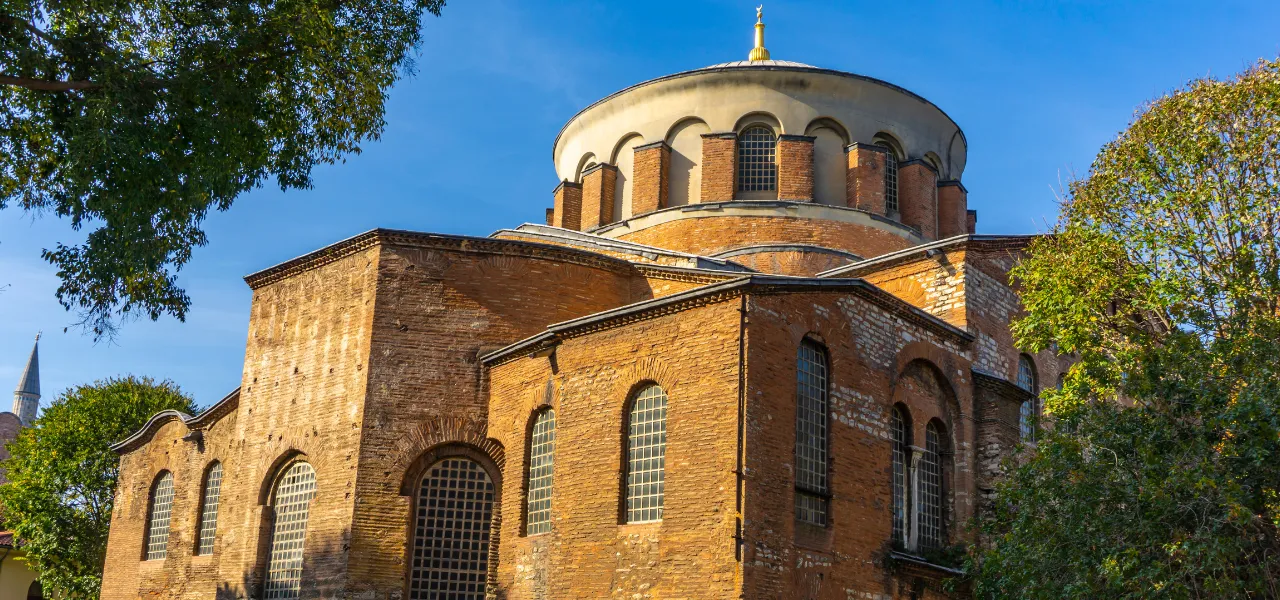
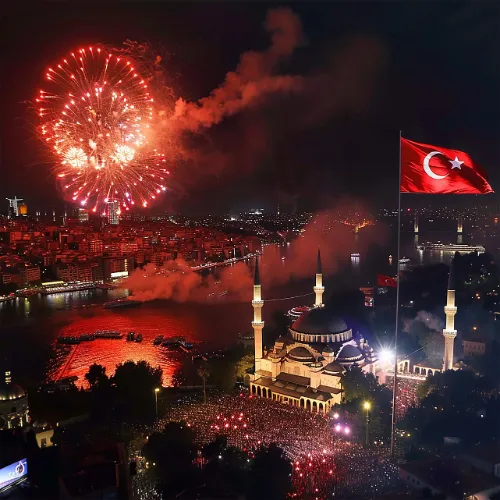
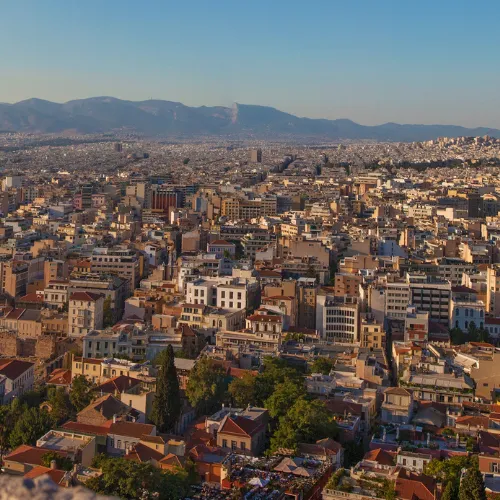
2nd Day – Istanbul
3rd Day / Thyatira – Sardis – Philadelphia
Thyatira
The fourth Church, ancient Thyatira now lies within Akhisar. Once a city famed for bronze work and weaving, this modern city is now one of Turkey’s largest tobacco and olive oil growing regions. The ancient church featured in the book of revelations may be found in modern Akhisar’s Ulu Cami (Great Mosque). The building is a former Byzantine church that was converted following the Ottoman conquest of the region. The Church of Thyatira was told to persist in their beliefs, despite the lack of a strong church in the city. Today there are few suggestions that Christianity once thrived in the region. Thyatira was a wealthy commercial city. Jesus’ letter to Thyatira praises the church for having grown in faith and service (Revelation 2:19). The church’s downfall was its devotion to a false prophet that led some members to commit idolatry and immorality (Revelation 2:20). Although the false prophet remained unrepentant, Jesus affirms that the congregation can still repent by turning away from the prophet’s ways
Sardis
Sardis was one of the wealthiest Roman cities in the area. Home to a significant Jewish population, Sardis was a bustling city important to the growth of the Church in the area. Once a thriving trade centre, Sardis today features the remains of the Temple of Artemis, a Jewish synagogue, a Byzantine church and evidence of daily Roman life. Sardis is a smaller site but definitely worth the time to explore. Sardis was a city that had endured two surprise attacks despite its fortifications. Our Lord faults the church in Sardis for maintaining an outward appearance of being “alive,” while actually being spiritually dead (Revelation 3:1). Alluding to the city’s history of prior surprise attacks, Jesus warns the congregation to “wake up” and repent, lest he “come like a thief” to bestow His judgment
Philadelphia
Philadelphia was a thriving city under Roman rule. Modernday Alasehir (God’s City) is a titular see of the Roman Catholic Church. Artefacts from Alasehir’s colourful past are found throughout the city. The Church of St John and the St Jean Church are the key remaining Christian sites in the city. Philadelphia was home to a synagogue community hostile to Christians. Christ praises the Philadelphians for remaining faithful in the face of trials despite their limited strength (Rev. 3:8). Jesus does not reproach this congregation but condemns its persecutors. (Revelation 3:9). Christ promises that if Philadelphia’s congregants remain faithful to Him, He will protect them from the “hour of trial” and make them pillars in God’s heavenly temple
4th Day / Pamukkale – Laodicea
Pamukkale
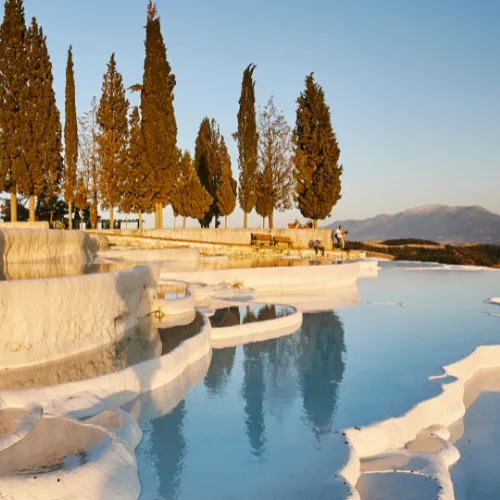
Hierapolis is an ancient city located on the top of Pamukkale and is a World Heritage site. There is a mixture of Pagan, Roman, Jewish and early Christian influences. Since the hot springs of Pamukkale were used as a spa since the 2nd century, people came to Hierapolis to soothe their ailments and often retire and die. The ruins sprawl over a large area and there is a large necropolis filled with sarcophagi.
The baths were made from large stone blocks and there are various open and closed areas linked together. The complex was constructed in the 2nd century and there are few historical facts known about the origin of the city. Many of the statues were transported to museums across the world and in 1970 a museum was built onsite.
Laodicea
Laodicea was, in ancient times, a key city in the area. Important for trade and as an important Christian site, Laodicea lies a few hours to the north of modern Denizli. The city was ruined many times by earthquakes, before ultimately being abandoned. Now, excavation and restoration projects are being carefully carried out, revealing the history and importance of the site. The reconstructed Basilicas feature intricate mosaics and are sure to delight visitors and are most definitely worth the time to explore. Laodicea was a prosperous industrial and commercial center. Jesus’ letter to this church wastes no time denouncing the congregation for its lukewarm faith, threatening to “spit” the congregation out of His mouth (Revelation 3:16). Christ scolds this church for allowing its economic prosperity to cause it spiritual bankruptcy and reveals that, despite its economic wealth, only He can provide spiritual wealth
5th Day / Ephesus
Ephesus
The first church is in Ephesus, where St John lived. Because Ephesus was an important Roman city, the Church congregation here is believed to have been quite strong, with Christianity eventually becoming the city’s chief religion. Today, visitors can enjoy taking in the sites of the Roman city and key sites of Christian history. Mary’s house and the tomb of St. John are key sites of interest, St Mary is
believed to have lived out her days here before being buried in the Church of Mary. Ephesus was the prominent commercial and cultural center of Asia. Christ’s letter to the Ephesian church praises the congregation for its “deeds…hard work…and perseverance,” and for its rejection of false apostles
6th Day / Smyrna – Pergamum
Smyrna
Smyrna in ancient times was a very wealthy and powerful city, indeed it vied with Ephesus and Pergamon for influence in the region. Today, Smyrna is located within modern-day Izmir, a city that has almost continuously been inhabited for centuries. The ancient city of Smyrna was largely absorbed into the city and, as such, there are remnants of ancient life throughout. The most important historical structure is the Agora, one of the best-preserved structures of ancient Ionia. Christianity in Smyrna is thought to have developed out of the large Jewish population that used to live in the area, as people defected from Judaism and were baptised in the Christian faith. Smyrna was home to a large Jewish community hostile to Christians. The Bible notes that slanderous accusations by Jews against Christians had led to Christian persecution by Roman authorities
Pergamum
Pergamon is one of Turkey’s most interesting and visited ancient sites. Dating as far back as the Archaic Period, the surviving structures include the Theatre, the Temples of Athena and Dionysus and the Gymnasium. Pergamon was a large city, significant in both political and commercial arenas, citizens would have enjoyed full, busy lives. Christianity in Pergamon was at odds with the city’s strong belief and history of worship of Pagan Gods. This clash of the Christian and the Pagan is something that the letter to the Church addressed, praising those who held fast in their Christian faith and admonishing those who persisted in the worship of pagan Gods. The city of Pergamum was renowned for its pagan practices. The letter to the church there lauds the congregation for upholding its faith despite the city’s pervasive pagan influences (Revelation 2:13). The letter then addresses the church’s sin by denouncing some of its members for following false teachings that brought about religious and moral compromise
7th Day / Canakkale – Troy
Troy
Troy, with its 4,000 years of history, is one of the most famous archaeological sites in the world. The first excavations at the site were
undertaken by the famous archaeologist Heinrich Schliemann in 1870. In scientific terms, its extensive remains are the most significant demonstration of the first contact between the civilizations of Anatolia and the Mediterranean world. Moreover, the siege of
Troy by Spartan and Achaean warriors from Greece in the 13th or 12th century B.C., immortalized by Homer in the Iliad, has inspired great creative artists throughout the world ever since.